

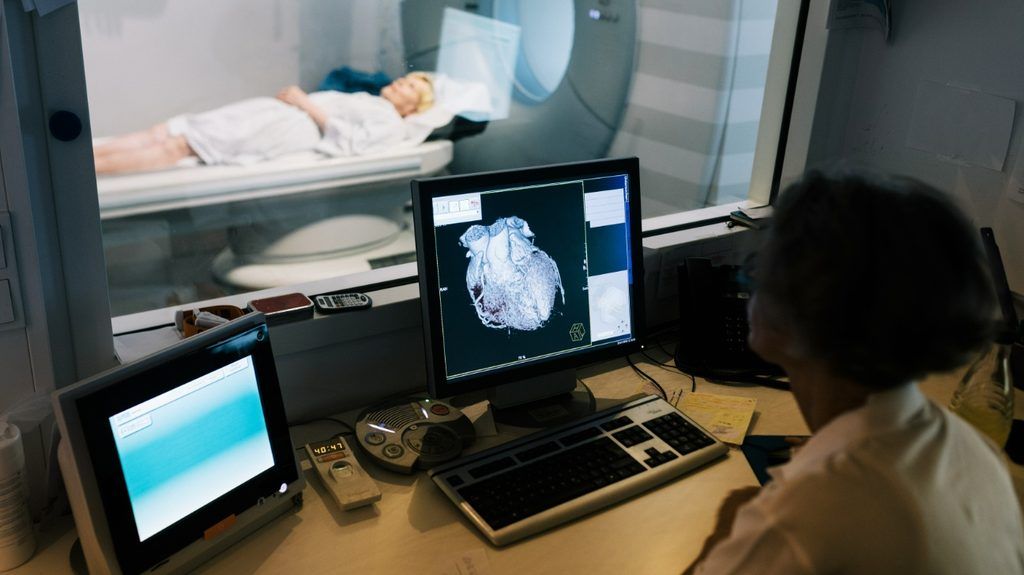
- A big research means that synthetic intelligence (AI) measurements of coronary heart perform from MRI scans have been barely, however considerably, higher at figuring out these at elevated danger of demise than measurements made by skilled clinicians.
- The AI instrument analyzed scans in roughly 2 to three seconds per affected person, in contrast with round 13 minutes for skilled clinician evaluation.
- Though the AI instrument demonstrated constant efficiency, it had an roughly 1% error price on the affected person stage, suggesting clinicians ought to proceed to confirm outcomes and interpret findings.
- The findings assist the potential use of AI as a first-line instrument for cardiac MRI evaluation, with skilled assessment the place vital.
Cardiac MRI scans can present detailed photographs of the center, permitting clinicians to evaluate its buildings and performance. One key measurement is ejection fraction, which represents the proportion of blood pumped out of the center’s predominant pumping chamber with every contraction.
Clinicians can calculate this by analyzing MRI photographs taken at completely different phases of the cardiac cycle to measure the amount of blood within the coronary heart because it fills and contracts. This measurement will help assess coronary heart perform and information selections about remedy.
Now, analysis means that synthetic intelligence (AI) could also be simpler than clinicians at utilizing coronary heart MRI scans to foretell affected person survival, doubtlessly serving to pace up coronary heart assessments and assist medical decision-making.
The research, printed in
Nevertheless, the researchers emphasize that clinicians ought to proceed to assessment AI-generated outcomes and interpret them within the context of every affected person’s general well being.
Researchers from Metropolis St George’s, College of London, and College Faculty London (UCL) — each in the UK — analyzed MRI scans from 27,382 sufferers within the U.Okay. and the USA present process investigation for recognized or suspected coronary heart situations.
Contributors have been adopted for a mean of greater than 5 years, throughout which 3,458 deaths have been recorded.
The research targeted on ejection fraction, which will help docs decide whether or not an individual could profit from sure coronary heart failure medicines, implanted cardiac units, or procedures to enhance blood movement to the center. It might probably additionally assist assess surgical danger and monitor coronary heart perform throughout chemotherapy.
The workforce in contrast ejection fraction measurements produced by an AI instrument with these made by skilled clinicians reviewing the identical kind of scans.
Their evaluation discovered that AI-derived measurements have been barely however considerably higher at figuring out sufferers at elevated danger of demise. This affiliation remained statistically important after the researchers accounted for components together with age and intercourse.
“The development that we discovered was small, however throughout hundreds of sufferers, small beneficial properties in precision may very well be significant, particularly for sufferers at highest danger,” lead research creator George Joy, MBBS, MRCP, an NIHR Scientific Lecturer at Metropolis St George’s, College of London, instructed Medical Information At this time. “Simply as essential, AI can carry out in seconds, constantly, and at very low price.”
“Ejection fraction is among the most essential measures of coronary heart perform,” Pleasure defined. “Docs use it to determine on a variety of therapies, for instance coronary heart failure medicine and implantable units.”
“We discovered that ejection fraction measured by AI was barely extra strongly linked to how lengthy sufferers survive, than measurements made by docs. AI measurements are quick and low-cost, and in some hospitals they’re prepared earlier than the affected person has left the scanner. So AI might grow to be the first-line measurement, with docs reviewing it relatively than manually measuring it themselves, which is time consuming. That frees docs as much as concentrate on extra advanced duties, resembling decoding the outcome alongside different check outcomes and what they imply for the affected person’s general well being.”
– George Pleasure, MBBS, MRCP
Along with its predictive efficiency, the AI instrument was considerably sooner than conventional clinician evaluation.
The system might analyse a cardiac MRI scan in roughly 3 seconds per affected person. Earlier analysis by the identical workforce discovered that skilled clinicians sometimes required round 13 minutes to carry out their evaluation.
This distinction might have sensible implications for healthcare companies, notably as demand for diagnostic imaging will increase.
If carried out successfully, AI-assisted evaluation might assist clinicians assess extra scans in much less time, doubtlessly enhancing workflow and supporting extra well timed medical selections.
Nevertheless, sooner evaluation doesn’t essentially imply that sufferers will obtain remedy sooner or expertise higher well being outcomes. Additional analysis can be vital to ascertain whether or not utilizing the expertise in routine medical apply results in measurable enhancements in affected person care.
Though the findings assist the potential use of AI in cardiac imaging, the researchers stress that the expertise mustn’t substitute medical judgement.
The AI instrument had an error price of roughly 1% on the affected person stage. These findings counsel that the system carried out constantly throughout the scans analyzed, however the researchers spotlight the significance of checking its outputs.
“Errors have been unusual, affecting round 1% of sufferers,” Pleasure famous. “Once they did occur, they led to ejection fraction (coronary heart perform) being both overestimated or underestimated. Each matter – that’s why a clinician ought to nonetheless assessment each outcome and remeasure the place wanted. We suggest that AI does the routine measuring; the physician checks it and interprets it.”
Cardiac MRI interpretation includes greater than measuring ejection fraction alone. Clinicians should additionally take into account different imaging findings, a affected person’s signs, medical historical past, and outcomes from further exams when deciding on an applicable course of remedy.
By automating a time-consuming measurement, AI might doubtlessly cut back a few of the workload related to cardiac MRI evaluation. It might additionally assist standardize measurements between assessments.
Thus, the findings assist an method wherein AI performs preliminary measurements, with clinicians reviewing outcomes the place vital and retaining duty for medical interpretation.
Nevertheless, the research primarily examined the connection between AI-derived measurements and subsequent mortality. It didn’t set up that introducing AI into medical apply straight reduces deaths or improves remedy outcomes.
Additional analysis can be essential to find out how the expertise performs throughout completely different affected person populations, medical settings, and MRI methods, in addition to how finest to combine it into present diagnostic pathways.
The analysis workforce plans to analyze whether or not combining AI-derived measurements from cardiac MRI scans with data from different exams might assist establish coronary heart issues earlier. One space of curiosity is the electrocardiogram (ECG).
Combining data from cardiac imaging and ECGs might doubtlessly assist establish abnormalities within the coronary heart muscle earlier than extra substantial harm develops. Earlier identification could give clinicians a chance to analyze issues and take into account remedy sooner.
Total, the findings counsel that AI might grow to be a great tool for measuring coronary heart perform and figuring out these at elevated danger of demise. Nevertheless, additional work is critical to find out whether or not its use in routine care can translate into higher outcomes for sufferers.


