
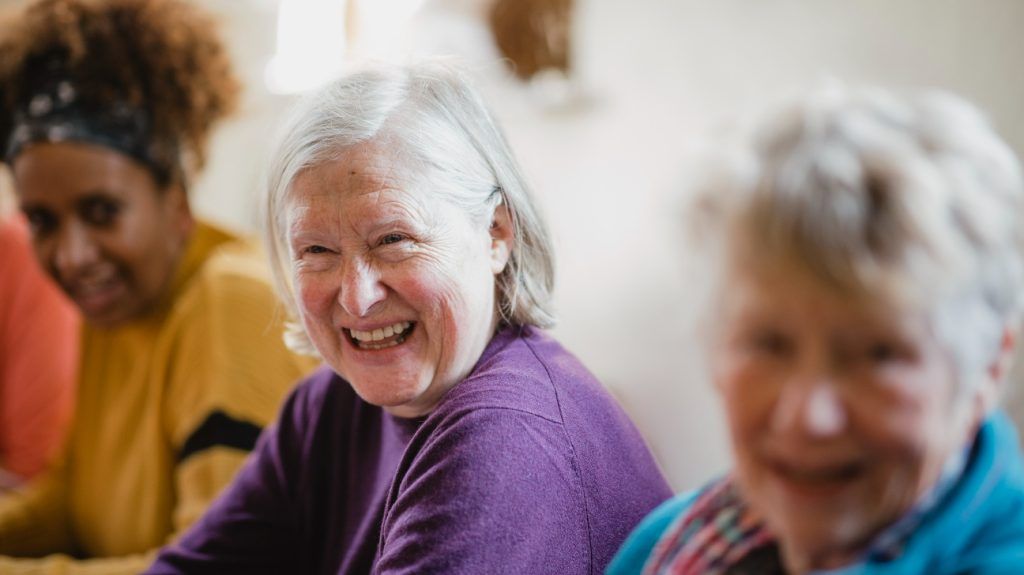
- Older adults who interact in three or extra social actions could expertise higher reminiscence and government operate in contrast with those that are much less socially energetic, in line with new analysis.
- Volunteering and taking part in sports activities membership actions have been related to a lowered danger of cognitive decline throughout a number of nationwide surveys.
- The findings align with the “use it or lose it” speculation, which means that stimulating actions could assist help cognitive operate in older age, although the research can’t verify whether or not social inactivity causes decline.
Collaborating in social actions, equivalent to volunteering and attending sports activities golf equipment, might assist enhance cognition in older age.
Whereas social isolation is a known risk for dementia, analysis into the affiliation between social exercise and each cognitive operate and dementia danger has produced “inconsistent” findings, in line with the researchers.
The brand new research aimed to guage the potential hyperlink between cognitive enhancement and social actions. The researchers assessed knowledge from 5 nationally consultant surveys throughout 24 international locations, with every survey containing comparable data.
By evaluating the kind and quantity of social actions every participant did with the cognitive scores obtained at totally different factors within the survey, researchers have been in a position to apply a z-score to find out the influence social exercise had on cognitive operate.
They discovered that people with greater z-scores have been extra more likely to interact in a wide range of social actions.
The research discovered that older adults who engaged in social actions, notably in three or extra, had greater cognitive z-scores, suggesting higher memory and government operate.
Normally, those that reported engagement in social exercise had greater cognitive scores in contrast with those that didn’t participate in social exercise.
Z-scores progressively elevated based mostly on the variety of social actions, with these concerned in 3 or extra actions experiencing the very best cognitive scores.
Medical Information At present requested Seán Kennelly, MB, PhD, FRCP (Lond), FRCPI, FTCD, Marketing consultant Geriatrician and Cognitive Specialist and Medical Director at Re:Cognition Well being Dublin whether or not he was stunned by these findings.
“No, I’m in no way stunned by these findings. Now we have recognized for a while that staying socially linked is sweet for our total well being and wellbeing, and there’s rising proof that it’s additionally essential for sustaining good mind well being as we become older,” mentioned Kennelly, who was not concerned within the research.
“Once we socialise, we’re really giving our brains fairly a exercise. We’re listening, remembering conversations, deciphering feelings, studying facial expressions, making choices, and responding to others, typically all on the similar time. It’s an extremely advanced psychological exercise, although we hardly ever consider it that method,” he added.
“What’s notably encouraging about this research is its dimension, involving nearly 58,000 individuals throughout 24 international locations. […] Whereas we will’t say from this research that socialising straight prevents cognitive decline, it provides additional weight to the proof that remaining socially energetic is a crucial a part of wholesome mind ageing.”
Taking part in sports activities membership actions and volunteer work was related to a lowered danger of cognitive decline in all surveys.
Some actions, equivalent to caring for youngsters and attending coaching programs, have been extra more likely to enhance cognitive scores annually.
Nonetheless, not all actions benefited cognition. Participation in church, non secular, political, or neighborhood teams was not constantly related to enhancements in cognitive operate.
Shannel Elhelou, PsyD, neuropsychologist and founding father of Mind Centric Neuropsychology in Westlake Village, CA, mentioned with MNT why totally different actions might have an effect on cognition.
“Actions interact us in numerous methods,” defined Elhelou, who was not concerned within the research. “Volunteering can present goal and alternatives for problem-solving, sports activities golf equipment mix motion with social connection, and programs or little one care contain studying, planning, and communication.”
She added, “The kind of exercise could matter, however private curiosity and delight are additionally essential for sustaining participation.”
Kennelly agreed that enjoyment performs an essential position in selecting social actions.
“I wouldn’t essentially say that one specific exercise is healthier than one other. What in all probability issues most is that persons are doing one thing they get pleasure from, that challenges them ultimately, and retains them linked with others,” he mentioned.
Whereas the research findings present an affiliation between social exercise and cognitive operate, they can not verify whether or not social inactivity may cause cognitive decline.
Nonetheless, the researchers recommend that the findings are in keeping with the “use it or lose it” speculation, which proposes that participating in stimulating actions could assist help cognitive operate, notably in older adults.
MNT requested Kennelly and Elhelou about how vital the speculation might be in lowering the danger of dementia.
“It’s a helpful method to describe the potential worth of staying mentally and socially engaged. Nonetheless, dementia danger displays many interacting elements. Engagement is greatest seen as one a part of a broader strategy to mind well being, alongside bodily exercise, sleep, and administration of cardiovascular danger elements,” mentioned Elhelou.
Kennelly added, “I feel we will really be somewhat extra bold than the normal ‘use it or lose it’ precept after we speak about mind well being. Our brains retain a outstanding skill to adapt, study, and develop all through our lives.”
He defined that, “[e]ven as we become older, we have now loads of alternatives to strengthen the connections inside our brains and proceed to construct what we name cognitive reserve.”
Kennelly described cognitive reserve as “basically the mind’s skill to deal with the modifications that happen as we age, together with the modifications related to ailments equivalent to Alzheimer’s,” including:
“We all know that folks with better cognitive reserve are typically extra resilient to the consequences of those ailments, that means they could keep their reminiscence and pondering talents for longer, even when among the underlying illness modifications are already current within the mind.”
He concluded, “Staying mentally and socially energetic can’t assure that somebody gained’t develop dementia. However the actually encouraging message is that we don’t merely have to simply accept cognitive decline as an inevitable a part of getting older. We will proceed to problem, strengthen, and help our mind well being all through our lives.”